Friday, 3 April 2015

Neurons

The Structure of a Neuron

1 Neurons
a.     have specialized cell structures that enable them to transmit nerve impulse.
b.     Have different types but all have 4 common features:
                                               i.     Dentrites
1.     short, branching terminals that receive nerve impulses from other neurons and relay the impulse to the cell body.
2.     Numerous and highly branched
                                              ii.     Cell body
1.     contains nucleus and site of cell’s metabolic reactions
2.     processes input from the dendrites
3.     if input is large, CB relays to axon
                                            iii.     Axon
1.     Conducts impulses away from the cell body
2.     Different lengths
                                            iv.     Branching ends
1.     Branches into many fibers
2.     Communicate with adjacent neurons, glands, muscles by releasing chemical signals into the space between it and the receptors.
c.      Some neurons- myelin sheath
                                               i.     Fatty insulating layer
                                              ii.     Gives axons a glistening white appearance
                                            iii.     Protects neurons and speeds the rate of nerve impulse transmission
                                            iv.     Composed of Schwann cells
Classifying Neurons
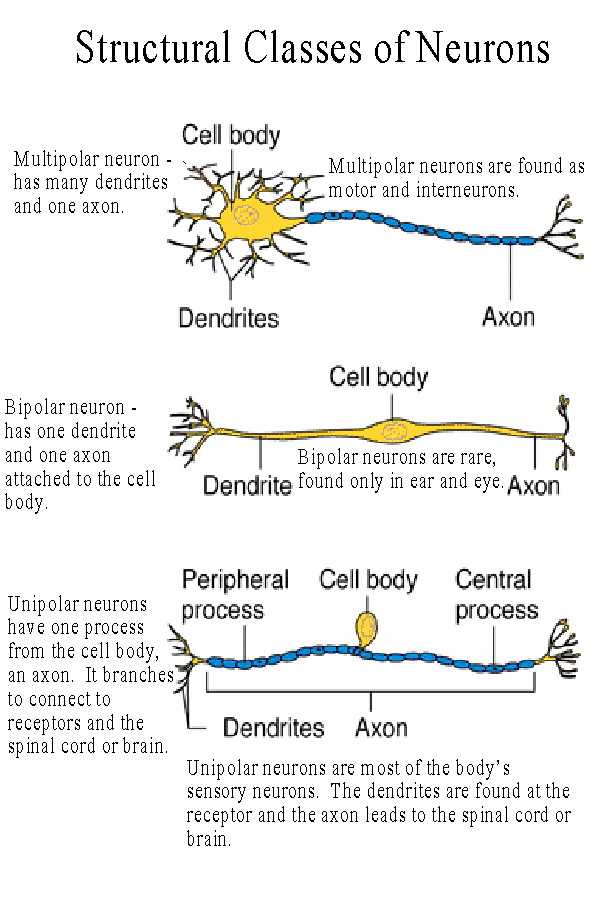
      I.         Three types of neurons (Structure)
a.     Multipolar
                                               i.     Several dendrites, single axon, found in brain and spinal cord
b.     Bipolar
                                               i.     Single dendrite, single axon, found in inner ear, retina, olfactory are of brain
c.      Unipolar
                                               i.     Singles process that extends from the cell body, dendrite and axon are fused, found in peripheral nervous system
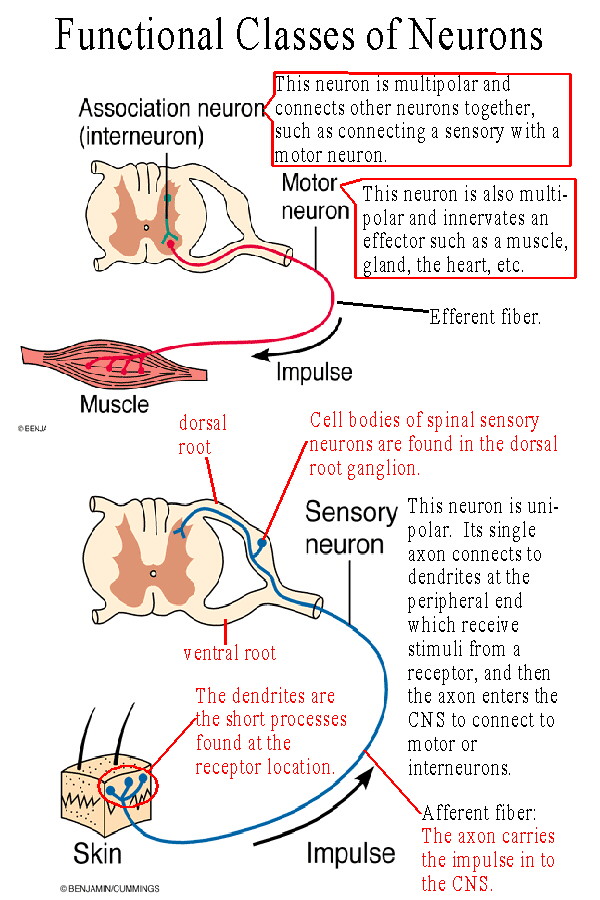
    II.         Three types of neurons (function)
a.     Sensory neurons (Sensory input)
                                               i.     Receive stimuli(ex. Skin) and nerve impulse
                                              ii.     Transmits impulses to central nervous system
b.     Interneurons
                                               i.     Found within central nervous system
                                              ii.     Link between sensory and motor
                                            iii.     Process and integrate incoming sensory information
c.      Motor neurons
                                               i.     Transmit information from the central nervous system to effectors (Ex.Muscles, glands, and other organs that respond to impulses from motor neurons)
Sensory input(collect information) > Integration > Motor output (effectors)

The Reflex Arc
      I.         Reflexes- sudden, involuntary responses to stimuli (ex. Blinking, vomiting, jerking hand from hot object)
    II.         Reflex arcs
a.     simple connections of neurons that explain reflexive behaviours.
b.     Usually involve three neurons

c.      Can be very rapid(Example, pressure of cactus needle)

Sunday, 29 March 2015

PCR, Sanger Sequencing and Vector Cloning (Compare and Contrast)

PCR (Polymerase Chain Reaction)
·      Definition: fast and inexpensive technique used to amplify small and targeted segments of DNA to produce million or billions of copies
·      Requirements: DNA template, taq polymerase, dNTP (dATP, dCTP, dGTP, dTTP), primers (2 known sequences)
·      Steps: Denaturation> Annealing> Extension
·      Denaturation: At 95%, the heat denatures the DNA into two single strands by breaking hydrogen bonds
·      Annealment: Cooled to 55%, primers bind to the 3' end of the target DNA at both strands
·      Extension, At 72%, nucleotides are added by taq polymerase
·      Applications: DNA fingerprinting,

Sanger Sequencing
·      Definition: most popular method of DNA sequencing developed by Fred Sanger
·      Requirements: DNA template, dNTP, DNA polymerase, primer (1 sequence), and ddNTP (fragments of various lengths will be synthesized)
·      Dideoxynucleotides are essentially the same as nucleotides except they contain a hydrogen group on the 3’ carbon instead of a hydroxyl group (OH).
·      Steps: Denaturation> Annealing> Extension (ddNTPs) > Gel electrophoresis
·      Gel electrophoresis is used to determine the DNA sequence (Shorter fragments to Longer fragments synthesized by ddNTP)

Vector Cloning
·      Definition: Makes use of a cloning vector (plasmid), a DNA molecule that carries foreign DNA into a host cell, replicates inside a bacterial (or yeast) cell and produces many copies of itself and the foreign DNA
·      Requirements: restriction enzymes(cuts DNA molecules at specific locations which must produce sticky ends), plasmid, gene of interest, bacteria, ligase 
·      Steps: Recombinant DNA (Foreign DNA to plasmid using restriction enzymes and ligase)>Transformation(DNA to bacteria)> Cloning > Purification
·      Bacteria are used as host cells because they grow rapidly and DNA can be easily isolated and reintroduced into their cells 
·      Application: prepare many copies of the gene

PCR & Sanger Sequencing
  • ·      PCR is used in Sanger Sequencing.
  • ·      PCR uses dNTP(makin copies of DNA) while Sanger Sequencing uses ddNTP(sequencing purposes)

PCR & Vector Cloning
  • ·      Both results to making copies of DNA
  • ·      Vector Cloning takes longer than PCR
  • ·      Vector Cloning uses plasmid, bacteria cells to make copies of gene while PCR uses primers, taq polymerase and dNTPs.

Sanger Sequencing and Vector Cloning
  • ·      Sanger Sequencing is used to sequence DNA while Vector Cloning is used to make copies of gene of interest using transformation and bacteria.

PCR, Sanger Sequencing and Vector Cloning
  • ·      All are processes and applications in Biotechnology.
  • ·      All of them requires gene of interest for different applications and purposes.


Monday, 2 March 2015

Translation

Translation
Synopsis: Translation is the process by which a protein is synthesized from the information contained in messenger RNA (mRNA).
Characters: tRNA, small and large ribosomal unit, codons, start and stop codons, anticodons, rRNA, ribosome
Plot: Initiation, Elongation, Termination

ACT I: Initiation
  • mRNA, the tRNA with the first amino acid (methionine)and two ribosomal subunits(small and large) gather together.
  • Small ribosomal subunits bind with the mRNA and the tRNA that has the methionine amino acid and then binds to the start codon (AUG).
  • Initiation factors bring large subunits such as the tRNA to take over the P site.


Act 2 - Elongation 

  • Anticodons of tRNA molecules bind to mRNA codons in the A site of the ribosome. 
  • rRNA catalyzes peptide bond formation among the polypeptide located in the P site with the amino acid in the A site.
  •  The tRNA molecule with the polypeptide is moved from the A site to the P site (translocation), and codons are matched with their respective anticodons in the 5' to 3' direction. After that, it exits at E site.
  • Process is repeated by entering a new codon at site.


Act 3 - Termination 

  • Translation continues until ribosome reaches 1 of the 3 stop codons (UGA, UAG and UAA).
  • Termination proteins bind to the ribosome and a release factor cuts the polypeptide chain from the last tRNA. 
  • Large and small subunit separates as ribosome released from mRNA.
VIDEO


Sunday, 1 March 2015

DNA Transcription

DNA Transcription

Synopsis: DNA Transcription is the synthesis of RNA from a DNA template where the code in the DNA is converted into a complementary RNA code.
Setting: Promoter Region
Characters: Antisense or template strand, Sense strand or coding strand, RNA polymerase II, transcription factors, 5' cap, poly-A tail, introns, exons
Plot: Initiation, Elongation, Termination

ACT I: Initiation

  • Transcription factors (TFs) identify and bind to the promoter region. (TATA Box)
  • RNA polymerase II binds to the transcription factors in DNA and forms a transcription initiation complex.

ACT II: Elongation

  • RNA Polymerase II synthesize a strand of pre-mRNA (complementary to template strand) by adding nucleotides to the 3' end of the growing pre-mRNA. Transcription goes from upstream towards downstream of the DNA strands in a 5' to 3' direction.
  • Pre-mRNA is anti-parallel with the template strand (Antisense), and it's similar with the coding strand (Sense) except U(pre-mRNA) and T(DNA strand). Uracil replaces thymine within the pre-mRNA.

ACT III: Termination

  • RNA Transcription stops when it reaches the terminator region (AAUAAA).
  • The pre-MRNA will undergo modification to mRNA.
    •  A 5' cap which has an altered form of guanine is added to the pre-mRNA strand for protectionand to indicate to ribosomes where to start. Also, a poly-A-tail is added to the 3' end (series of adenine nucleotides). 
    • RNA splicing occurs  where introns (non-coding regions) are removed from the transcript by making a loop, leaving only exons (coding segments), which is done by the splicosome, consisting of snRNPs and snRNA.
  • As a result, the mRNA strand is complete and ready for transport to the ribosomes.
  • Video


Saturday, 21 February 2015

DNA Replication

DNA Replication


Synopsis: DNA Replication is the process by which a double-stranded DNA molecule is copied to produce two identical DNA molecules. Each daughter DNA consists of one old DNA strand and one new DNA strand  Therefore, the process is semi-conservative.


Setting: Origin of Replication

Characters: Helicase, Single-strand binding proteins, Gyrase, RNA Primase, RNA Primers, Leading and Lagging Strand, Okazaki Fragments, Polymerase I, Ligase

Plot: Initiation, Elongation, Termination


ACT I: Initiation
  • Helicase unwinds the double stranded DNA by cleaving the hydrogen bonds that links the two strands together.
  • Single-strand binding proteins (SSBPs) stabilize these single DNA strands and keep the strands separated.
  • Gyrase relieves the strain coming from the unwinding process by cutting the DNA.
  • As a result,  two separated single DNA strands are formed as replication bubble.

ACT II: Elongation
  • After unwinding, RNA Primase attaches to DNA and creates RNA primers, which signals Polymerase III to begin replication.
  • Polymerase III attaches to the RNA primer and begins the replication process by adding nucleotides to the two parent strands, leading and lagging, in a 5' to 3' direction in a form of replication fork.

    • Leading strand is replicated into the replication fork. Thus, it allows the strands to be synthesized continuously
    • Lagging strand is replicated away from the replication fork and anti-parallel to the leading strand. Since strands are replicated away in a 5' to 3' direction, this does not allow Polymerase III to synthesize the strand in a continuous manner. Instead, it is synthesized in short fragments called Okazaki fragments.
ACT III: Termination

  • After replication, Polymerase I removes and replaces the primers and replication mistakes with correct DNA sequences.
  • Ligase glues and connects the gaps between the Okazaki fragments with a phosphodiester bond.


Video: https://www.youtube.com/watch?v=27TxKoFU2Nw
Notes: All proteins ending with ase are enzymes.